


Fill out our script request form so we can send you a script to peruse and more info about what these translations look like in production.
“Something miraculous happened for Mfoniso. She heard the rhythm of the play in an entirely new way. An artist who is highly sensitive to the different rhythms of speech patterns in colloquial English and African immigrants’ use of English, Mfoniso wanted to emphasize the different rhythmic qualities of Othello’s speech from everyone else’s in the play.” Ayanna Thompson, Dramaturg
Playwright
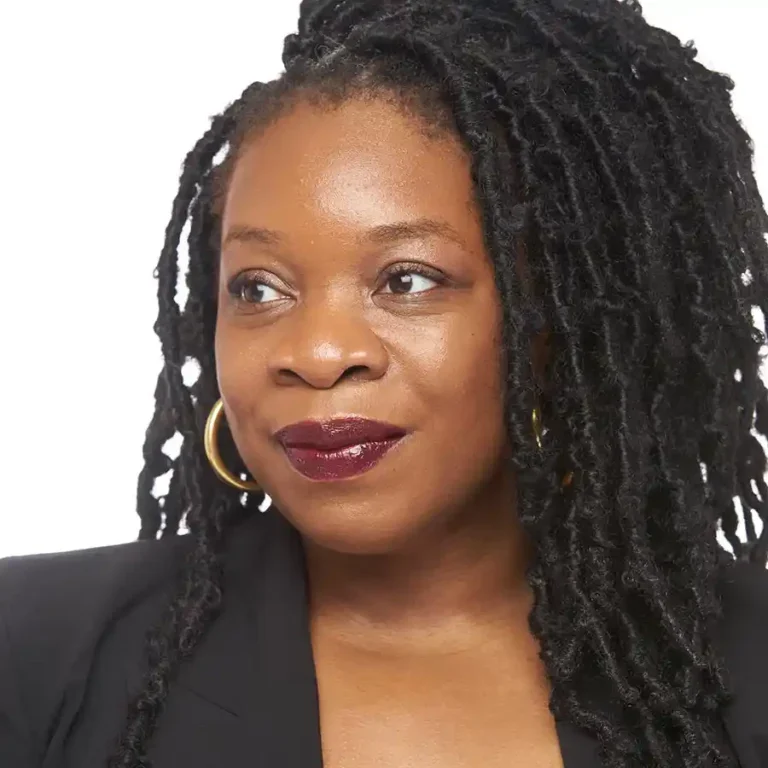
Mfoniso Udofia
MFONISO UDOFIA, a first-generation Nigerian-American storyteller and educator, attended Wellesley College, obtained her MFA from the American Conservatory Theater [ACT] and, while at ACT, co-pioneered, The Nia Project, which provided artistic outlets for youth residing in Bayview/Huntspoint.
Productions of her plays Sojourners, runboyrun, Her Portmanteau and In Old Age have been seen at New York Theatre Workshop, American Conservatory Theater, Playwrights Realm, Magic Theater, National Black Theatre, Strand Theater Company, and Boston Court. She’s the recipient of the 2017 Helen Merrill Playwright Award, the 2017-18 McKnight National Residency and Commission at The Playwrights’ Center and is a member of New Dramatists.
Mfoniso’s currently commissioned by Hartford Stage, Denver Center, ACT, and South Coast Repertory. Her plays have been developed by Manhattan Theatre Club, ACT, McCarter Theatre, OSF, New Dramatists, PCS’s JAW Festival, Berkeley Rep’s Ground Floor, The OCC, Hedgebrook, Sundance Theatre Lab, Space on Ryder Farm, Page 73, New Black Fest, Rising Circle and more.
She has worked as a television writer on: 13 Reasons Why, Little America, Pachinko, A League of Their Own and Let the Right One In.
Follow her at @mfudofia or visit www.mfonisoudofia.com
Dramaturg

Alex Barron
Alex Barron is a dramaturg and producer based in New York. He worked on the artistic staffs of MCC Theater, SPACE on Ryder Farm, The Playwrights Realm, The Sundance Institute, and Manhattan Theatre Club. As a dramaturg, he’s developed new plays at the Sundance Theatre Lab, New York Stage and Film, The O’Neill Center, The Public Theater, and the Denver Center, among others. Alex is an audio producer at The New York Times, and has produced, directed, and designed audio projects for The New Yorker, Audible, and New York Theatre Workshop, among others.

Ayanna Thompson
Ayanna Thompson is a Regents Professor of English at Arizona State University, and the Director of the Arizona Center for Medieval & Renaissance Studies (ACMRS). She is the author of Blackface (Bloomsbury, 2021), Shakespeare in the Theatre: Peter Sellars (Arden Bloomsbury, 2018), Teaching Shakespeare with Purpose: A Student-Centred Approach, co-authored with Laura Turchi (Arden Bloomsbury, 2016), Passing Strange: Shakespeare, Race,and Contemporary America (Oxford University Press, 2011), and Performing Race and Tortureon the Early Modern Stage (Routledge, 2008).
She wrote the new introduction for the revised Arden3 Othello (Arden, 2016), and is the editor of The Cambridge Companion to Shakespeare and Race (Cambridge University Press, 2021), Weyward Macbeth: Intersections of Race and Performance (Palgrave, 2010), and Colorblind Shakespeare: New Perspectives on Race and Performance (Routledge, 2006).
She is currently collaborating with Curtis Perry on the Arden4 edition of Titus Andronicus. Thompson is a Shakespeare Scholar in Residence at The Public Theater in New York. She currently chairs the Council of Scholars at Theatre for a New Audience in Brooklyn, NY, serveson the Board of Play On Shakespeare, and previously served on the Board for Woolly Mammoth Theater in Washington, DC.
She was the 2018-19 President of the Shakespeare Association of America and was one of PhiBeta Kappa’s Visiting Scholars for 2017-2018. From 2015-2017, Thompson served as a member of the Board of Directors for the Association of Marshall Scholars.
In Print
Othello
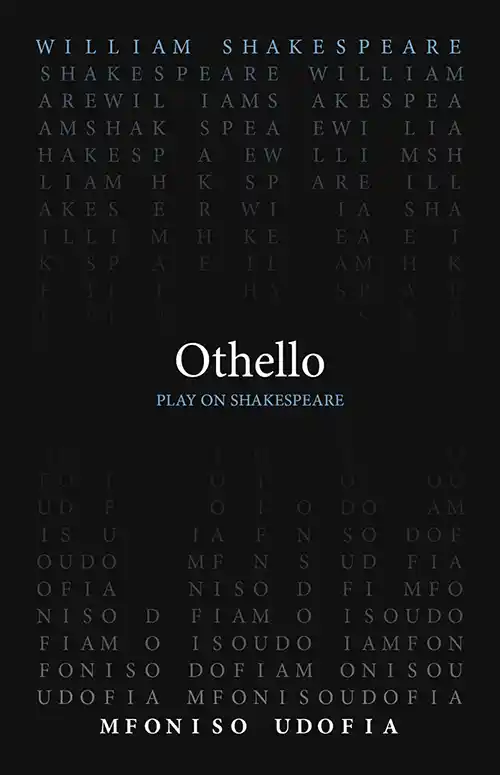
A contemporary translation that emphasizes the racial malice at the heart of Shakespeare’s play.
In her update of Shakespeare’s Othello, Mfoniso Udofia engages with the racial malice at the heart of the play. Udofia’s take on this complicated story emphasizes the rhythm and lyrical patterns of Othello’s speech. Opening up the text to modern ears, Udofia presents us with a code-switched Othello.